CVC STORIES
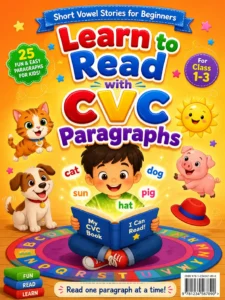
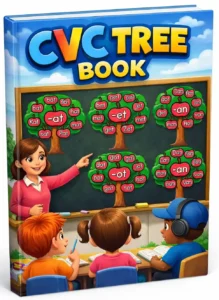
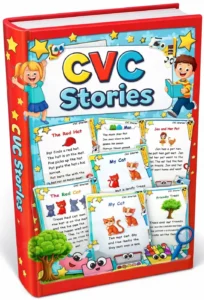
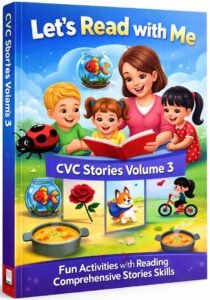
CVC STORIES are the perfect next step for children who have mastered individual CVC words (consonant-vowel-consonant words like “cat,” “dog,” and “sun”) and short phrases. While flashcards and word lists build decoding skills, stories bring those words to life. A well-written CVC story uses only three-letter words and a few common sight words, allowing young readers to experience the joy of reading real narratives. In this blog, we will explore why CVC STORIES boost comprehension, confidence, and a lifelong love for books.
Why CVC Stories Matter
Many children learn to sound out “c-a-t” and “m-a-t” but struggle when faced with a full page of text. CVC STORIES solve this problem by limiting vocabulary to decodable words. For example, a simple story might read: “The fat cat sat. The cat had a red hat. The cat ran to the mat.” Every word is within the child’s decoding ability. Reading CVC STORIES gives beginners a safe space to practice fluency without frustration. They learn to pause at periods, recognize word patterns, and understand that print carries meaning.
From Decoding to Comprehension
Decoding is not the same as reading. A child may say “d-o-g” but have no idea the sentence was about a pet. CVC STORIES bridge this gap because short, predictable plots make comprehension easy. After reading a story like “The big bus,” you can ask: “What was big? Where did the bus go?” These simple questions teach children to think about what they just read. Using CVC STORIES regularly transforms hesitant decoders into active readers who can retell a story in their own words.
How to Write Your Own CVC Stories
You do not need to be a professional author to create effective CVC STORIES. Follow these simple rules:
Use mostly CVC words (cat, big, run, hop, wet, sun, log)
Add a few high-frequency sight words (the, a, is, on, and, to)
Keep sentences short – 4 to 6 words maximum
Repeat word families for practice: “Dan has a van. The van can go fast. Dan and his van have fun.”
Include a clear beginning, middle, and end (even if very simple)
One excellent CVC STORIES example: “The pup is in the mud. The pup is wet. Mom rubs the pup. Now the pup is dry.” This story has a problem (wet pup) and a solution (mom rubs).
Fun Activities with CVC Stories
Illustrate the Story – After reading, let the child draw what happened.
Act It Out – Use toys or puppets to retell the CVC STORIES.
Fill in the Blank – Write the story with one missing word per sentence. Child chooses the correct CVC word from a word bank.
These activities reinforce both decoding and comprehension. Just one CVC STORIES session per day – about 10 minutes of reading plus a short activity – builds skills faster than worksheets alone.
Recommended CVC Story Collections
Many free and paid resources offer ready-made CVC STORIES. Look for books labeled “decodable readers” or “phonics readers.” Some popular series include Bob Books, Primary Phonics, and free printable mini-books online. Always choose stories where at least 80% of the words are fully decodable for your child’s level.
Grow a Confident Reader
Every child deserves the excitement of finishing their first story. CVC STORIES make that possible. Start with one short tale today – perhaps about a “fat rat” or a “big bug.” Watch your child’s eyes shine as they read from beginning to end. That moment is the foundation of a lifetime of reading joy. Keep using CVC STORIES as your child progresses, and soon they will be ready for longer books. Read, learn, and grow – one story at a time.