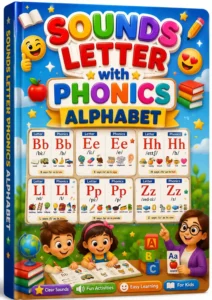
Sound Letter with Phonics Alphabet
Sound Letter with Phonics Alphabet is the foundational skill every young reader needs to unlock the world of words. Before children can read sentences or stories, they must understand that letters represent specific sounds. This approach—often called phonics—teaches the relationship between written symbols (letters) and spoken sounds. In this blog, we will explore why Sound Letter with Phonics Alphabet matters, how to teach it effectively, and fun activities that make learning joyful.
What Is Sound Letter with Phonics Alphabet?
Simply put, Sound Letter with Phonics Alphabet means learning each letter by its sound, not just its name. For example, the letter “B” is taught as /b/ (as in “ball”) rather than just “bee.” This method helps children blend sounds into words. When a child masters Sound Letter with Phonics Alphabet, they can look at a new word like “d-o-g” and say each sound: /d/ /o/ /g/ – then blend them into “dog.” Without this skill, reading becomes guesswork.
Why Phonics Beats Whole-Word Memorization
Some early reading programs ask children to memorize entire words as pictures. That approach works for a few dozen words but fails when learners face thousands of unfamiliar words. Sound Letter with Phonics Alphabet gives children a decoding toolkit. Research shows that systematic phonics instruction improves reading fluency, spelling, and comprehension. A child who knows Sound Letter with Phonics Alphabet can read “cat,” “bat,” “rat,” and “hat” without memorizing each one separately. They simply apply the sound of each letter.
How to Teach Sound Letter with Phonics Alphabet
Follow these simple, proven steps:
Start with a few letters – Introduce s, a, t, p, i, n first. These allow forming many simple words (sat, pin, tap).
Teach the pure sound – Say /m/ not “muh,” /t/ not “tuh.” Keep sounds crisp.
Use multi-sensory activities – Trace letters in sand while saying the sound. Sing alphabet phonics songs.
Practice blending – After learning 6–8 sounds, show how to push sounds together: /c/ /a/ /t/ → “cat.”
Daily 10-minute sessions of Sound Letter with Phonics Alphabet practice produce faster results than longer, infrequent lessons.
Fun Activities for Home or Classroom
Letter Sound Hunt – Hide magnetic letters around the room. Child finds one and says its sound.
Sound Sorting – Give pictures of a “bat,” “cat,” and “ball.” Child places them under B, C, or B again.
I Spy with Phonics – “I spy something that starts with /s/” (soap, sun, sock).
Always keep Sound Letter with Phonics Alphabet playful. Praise effort, not just accuracy.
Common Mistakes to Avoid
Teaching letter names before sounds (names come later).
Adding an extra “uh” to consonants (/k/ becomes “kuh”).
Moving too fast. Master 4–5 sounds before adding more.
Grow a Confident Reader
Every fluent reader started with the same small step: connecting a sound to a letter. By embracing Sound Letter with Phonics Alphabet, you give your child the key to independence. Start today—say the sound of “M,” find objects that start with /m/, and watch the magic unfold. Read, learn, and grow one sound at a time.