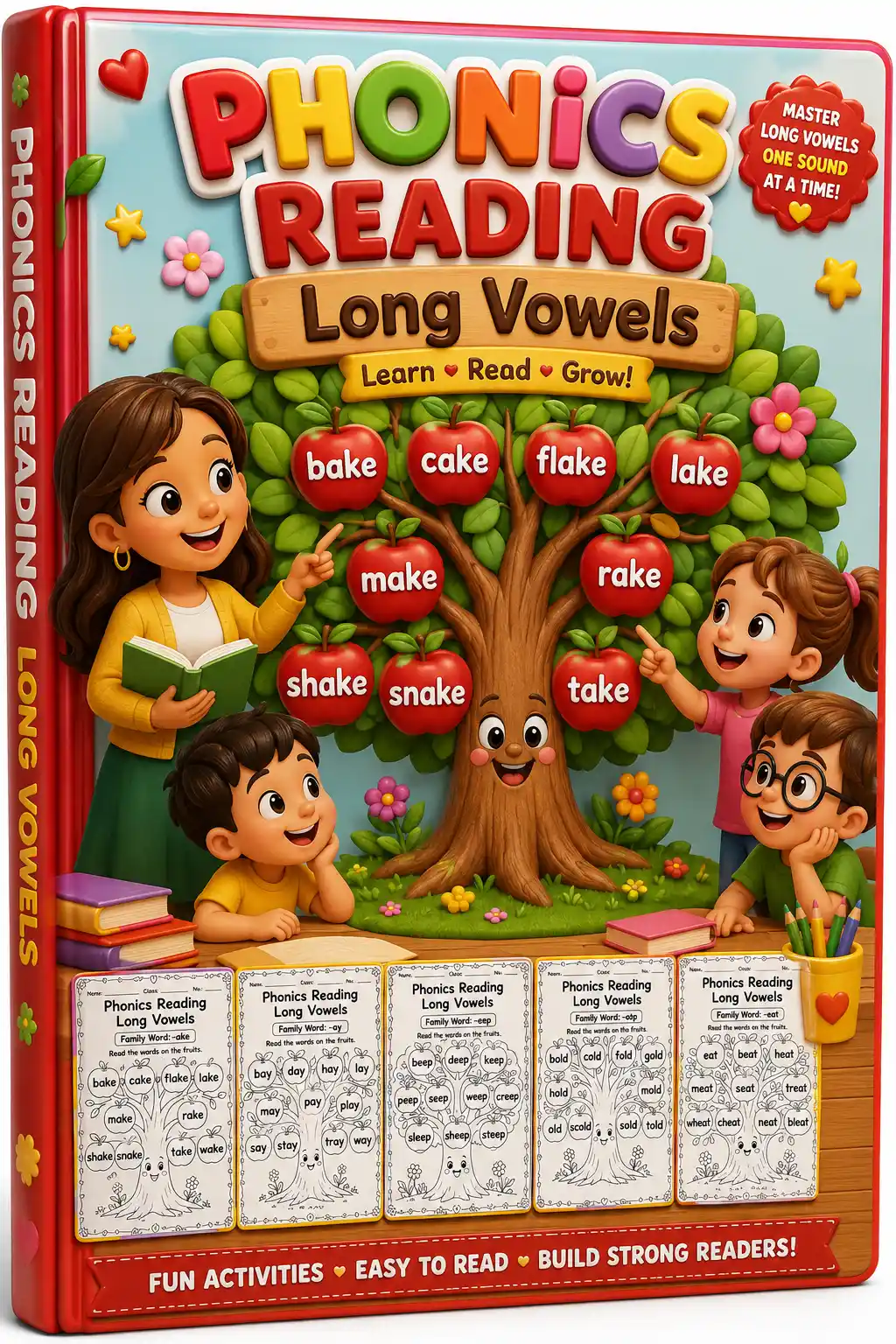
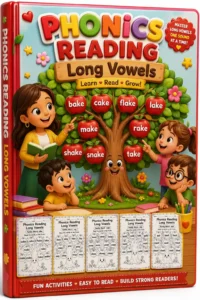
Phonics Reading Long Vowels
Phonics Reading Long Vowels is an essential next step for children who have mastered short vowel sounds. While short vowels appear in simple CVC words like “cat” and “bed,” long vowels say their own name—think “cake,” “bike,” “go,” and “cube.” Mastering this skill transforms early readers into fluent, confident learners. In this blog, we’ll explore why Phonics Reading Long Vowels matters, how to teach it effectively, and fun activities to reinforce learning.
What Are Long Vowels and Why Do They Matter?
Long vowels occur when a vowel says its letter name (A, E, I, O, U). For example, the “a” in “ape” sounds like the letter A, not the short “a” in “apple.” Phonics Reading Long Vowels helps children recognize common spelling patterns such as “magic e” (bike, hope), vowel teams (boat, rain, play), and open syllables (go, me, hi). Without this knowledge, young readers may stumble over words like “time” (confusing it with “tim”) or “seat” (reading it as “set”). A solid foundation in Phonics Reading Long Vowels prevents decoding errors and boosts reading speed.
Key Long Vowel Patterns to Teach
To make Phonics Reading Long Vowels easy and logical, introduce patterns one at a time:
Magic E (CVCe) – kit → kite, hop → hope, cub → cube. The final e makes the first vowel say its name.
Vowel Teams – ai/ay (rain, play), ea/ee (seat, tree), ie (pie), oa/oe (boat, toe), ue/ui (blue, fruit).
Open Syllables – he, she, we, go, so, my. No consonant after the vowel, so it stays long.
Y as a Vowel – fly, my (long i); sunny, baby (long e).
Practice each pattern with word sorts, flashcards, and decodable sentences. For example: “The rain fell on the train. Jake and Dave can play a game.”
Fun Activities for Teaching Long Vowels
Keep Phonics Reading Long Vowels engaging with hands-on games:
Magic E Wand – Write short vowel words on cards. Let kids add a paper “e” to the end and read the new word.
Vowel Team Bingo – Create bingo boards with long vowel words like “beach,” “coat,” and “pie.” Call out the word, and learners find it.
Read and Draw – Give sentences like “The goat floats in a boat.” Children draw the scene to show comprehension.
These activities work well in both classroom and homeschool settings. Just 15 minutes of daily Phonics Reading Long Vowels practice can dramatically improve decoding skills.
Common Mistakes and How to Fix Them
Some children confuse long and short vowels, reading “fine” as “fin.” Others mix up similar vowel teams (like “ea” and “ee”). To address this, use contrast drills: show “pin” vs. “pine,” “tap” vs. “tape.” Always read words in context, not isolation. A short story with multiple long vowel examples reinforces correct pronunciation naturally.
Grow Into a Skilled Reader
Moving from short vowels to Phonics Reading Long Vowels is a milestone that opens up thousands of new words. With consistent, playful practice, children will no longer fear words like “dream” or “smile.” They will read smoothly, understand deeply, and enjoy every book that comes their way. Start today—pick one long vowel pattern and explore it through stories, games, and conversations. Your young reader will thank you.